
 Iqbal Shahid
 History teaches that when public trust in elections begins to erode, the consequences can extend far beyond the ballot box.
An Election Under a Shadow
The first phase of the Azad Jammu and Kashmir (AJK) Legislative Assembly elections should have been remembered as another democratic milestone. Instead, it concluded amid reports of violence, the death of a political worker, and allegations of electoral rigging by the Pakistan Peoples Party (PPP) against the ruling Pakistan Muslim League-Nawaz (PML-N). The ruling party has rejected those allegations, while election authorities have initiated inquiries into reported irregularities.
The political backdrop made the elections even more unusual. Pakistan Tehreek-e-Insaf (PTI) boycotted the polls, arguing that the prevailing environment did not permit a genuinely representative electoral process. The Joint Awami Action Committee (JAAC), whose protest movement has dominated AJK’s political landscape over the past two years, also stayed away from the elections.
The polls were held amid weeks of political unrest, violent clashes, conflicting casualty claims, and extensive international media attention, underscoring the extraordinary circumstances in which the electoral process was conducted.
Whether the decision by PTI and the Joint Awami Action Committee (JAAC) to stay away from the electoral process was justified or not is a matter of political debate. What is beyond debate, however, is that elections held amid controversy in a politically sensitive region deserve careful national reflection.
A Lesson from 1987
History offers Pakistan an important lesson.
The 1987 Legislative Assembly election in Indian-occupied Jammu and Kashmir is widely regarded by historians and political scholars as one of the defining turning points in the region’s modern history. The election pitted the National Conference-Congress alliance against the Muslim United Front (MUF), a coalition that had mobilised unprecedented public enthusiasm, particularly among Kashmiri youth.
Following polling, widespread allegations emerged that the electoral process had been manipulated. Over the decades, a broad body of scholarship has concluded that the disputed election severely damaged public confidence in democratic politics. Many young political activists who had initially sought change through constitutional means abandoned that path, and the insurgency that erupted in 1989 transformed the Kashmir conflict for decades to come.
The lesson of 1987 is not merely about alleged electoral manipulation. It is about the long-term consequences that can follow when a significant section of society loses confidence that political grievances can be addressed through democratic institutions.
Why This Matters Today
No historical comparison is ever perfect, and today’s AJK is not the Kashmir Valley of 1987. Yet history often serves as a warning rather than a prophecy.
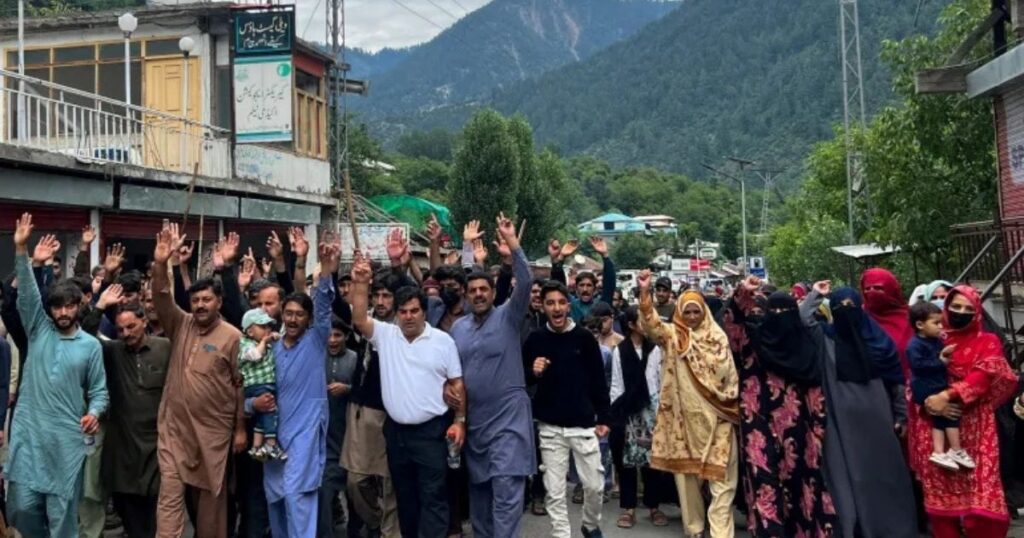
The present tensions in AJK did not begin with these elections. The JAAC movement, which emerged in 2024 around economic grievances and governance issues, gradually evolved into a broader political campaign. Repeated protests, negotiations, shutdowns and, more recently, violent clashes have resulted in tragic casualties among both protesters and law-enforcement personnel. These developments indicate that the region was already politically polarised before voters went to the polls.
Pakistan today faces an exceptionally complex security environment. Terrorist violence continues to challenge the state in Khyber Pakhtunkhwa, while Balochistan remains affected by a long-running insurgency and repeated terrorist attacks. The government has consistently maintained that hostile external actors seek to exploit these internal vulnerabilities. At a time when regional tensions remain high, political instability in Azad Jammu and Kashmir cannot be dismissed as a purely local issue.
This is precisely why the remaining phases of the elections assume such importance. Every credible allegation of electoral irregularity deserves an impartial and transparent investigation—not because one political party demands it, but because public confidence in democratic institutions is itself a national asset. Equally important, meaningful dialogue with peaceful political stakeholders should resume without delay. Durable political stability is achieved through constitutional engagement, not prolonged confrontation.
History does not repeat itself mechanically, but it often reminds nations of the cost of ignoring its lessons.Pakistan cannot afford another prolonged political fault line in Kashmir; ensuring that elections are not only free and fair but are also widely perceived to be so is both a democratic necessity and a strategic national imperative.
Selected References
- Dawn: Coverage of the first phase of the AJK elections and allegations of irregularities.
- Ahmed Bilal Mehboob, AJK Election and Beyond, Dawn.
- Sumit Ganguly, The Crisis in Kashmir.
- Sumantra Bose, Kashmir: Roots of Conflict, Paths to Peace.
- Victoria Schofield, Kashmir in Conflict.
- Christopher Snedden, Understanding Kashmir and Kashmiris.